
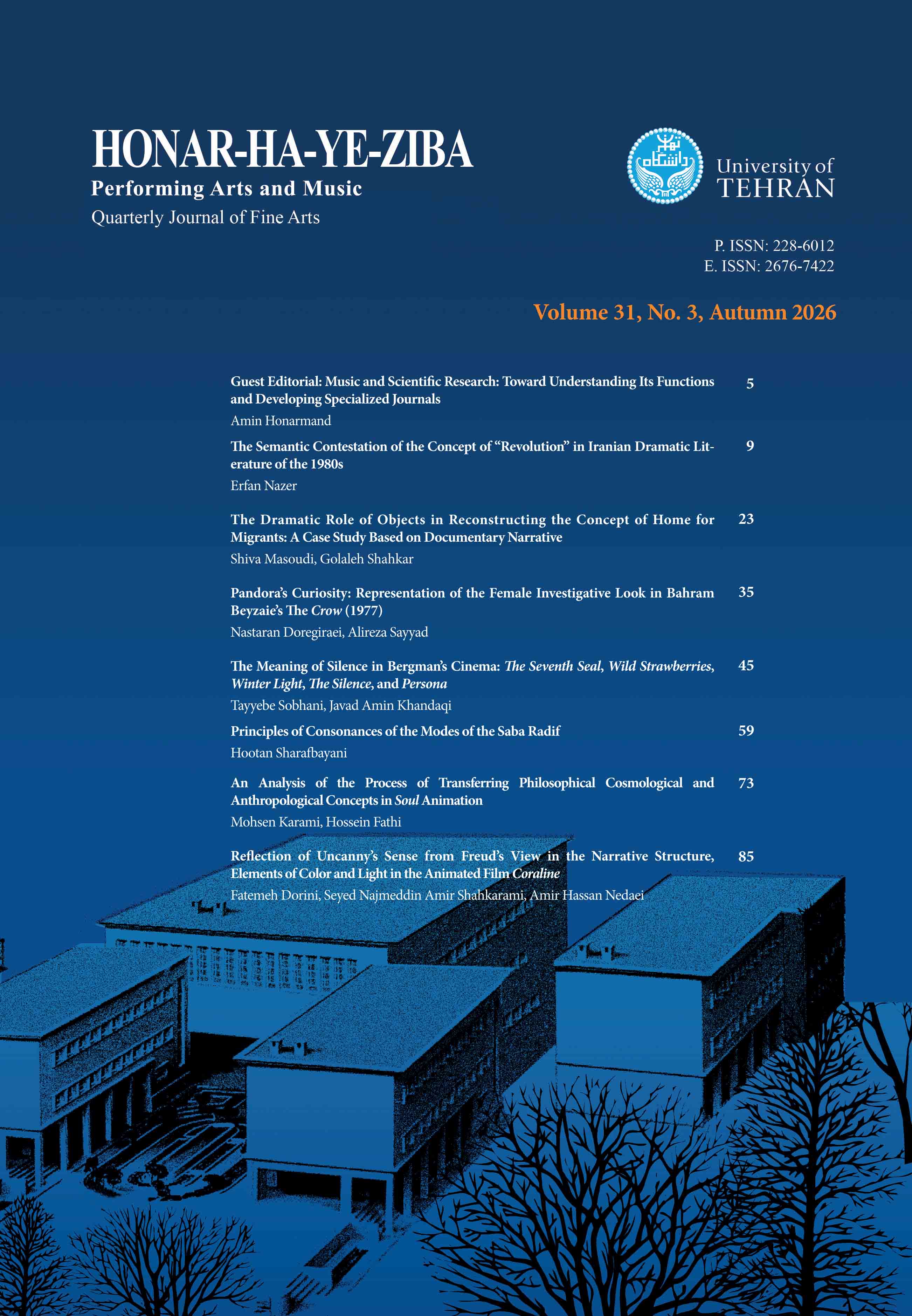
Journal of Fine Arts: Performing Arts and Music is a double-blind peer-reviewed, open access, quarterly journal which publishes theoretically and empirically research on all topics of theatre, drama, cinema, radio, classical and contemporary music, traditional Persian music, performing arts, new media, aesthetics, art philosophy and pedagogy. The journal introduces a wide range of performing art and recorded art topics with historical and contemporary perspectives. Accepted papers often reflect critical and comparative analysis. Our target audience include academicians, art educators, students, and artistic and performing communities at large. The submitted papers will be published after peer review and upon the approval of the editorial board. Journal of Fine Arts was originally published in 1995 to cover all aspects of art and was divided into three journals in 2009 with Journal of Fine Arts: Performing Arts and Music focusing on performing arts and music. Researchers may directly visit this site, register, submit and set up their papers based on author’s guidelines. This journal is known as "Honar-Ha-ye-Ziba: Honar-Ha-ye-Namayeshi va Moosighi" in the Persian language.
Email: fineartj@ut.ac.ir
• Journal Title: Journal of Fine Arts: Performing Arts and Music
• Country of Publication: Iran, Tehran.
• Publisher: University of Tehran Press
• Subject Area: theatre, drama, cinema, radio, classical and contemporary music, traditional Persian music, performing arts, and new media
• Format: Print and Online
• Print ISSN: 6012-2228
• Online ISSN: 7422-2676
• Frequency: Quarterly
• Language: Persian, including extended English abstracts and bibliographies
• Open Access: Yes, free access to articles
• Article types: Research and review papers
• Primary Review: 10 days, approximately
• Peer Review Policy: Double-blind peer-review
• Average refereeing time: 8 weeks
• Plagiarism Detection Mechanism: Through Irandoc
• Acceptance percentage: 20%
• Article Processing Charges: No
• Citation Style: The APA referencing style
• Website: https://jfadram.ut.ac.ir
• E-mail: fineartj@ut.ac.ir
• Tel: +98-2166415282
• Indexing & Abstracting: E-LIS Eprints, EBSCO, SID, Noormags, Magiran, Iran Journals, Google Scholar, Academia, Linkedin, Researchgate, etc.
• COPE: Journal of Fine Arts: Performing Arts and Music follows the policies and guidelines of the Committee on Publication Ethics (COPE) and abides by its Code of Conduct in dealing with potential cases of misconduct.
• Copyright: Authors retain unrestricted copyrights and publishing rights.
• Type of License: CC BY-NC - Creative Commons.
• Required files to be uploaded: Five essential files must be submitted through the manuscript submission system: 1. The main file of the manuscript (without the names of the authors), 2. Title page in the mentioned format, 3. Authorship form (must include the title of the article and the name and surname of all authors and be signed by all authors), 4. Conflicts of Interest form (must be signed by the Corresponding Author and uploaded with the article file), and 5. Cover letter.


.png)


Pages 5-8
Amin Honarmand
Pages 9-21
10.22059/jfadram.2025.390719.616057
Erfan Nazer
Pages 23-34
10.22059/jfadram.2025.388094.615994
shiva masoudi, golaleh shahkar
Pages 35-44
10.22059/jfadram.2025.393439.616060
Nastaran Doregiraei, Alireza Sayyad
Pages 45-57
10.22059/jfadram.2025.386751.615981
Tayyebe Sobhani, Javad Amin Khandaqi
Pages 59-71
10.22059/jfadram.2025.390162.616024
hootan sharafbayani
Pages 73-84
10.22059/jfadram.2025.386159.615977
Mohsen Karami, Hossein Fathi
Pages 85-95
10.22059/jfadram.2025.395928.616083
Fateme Dorini, Najmodin Amir Shahkarami, Amir Hassan Nedaei


